
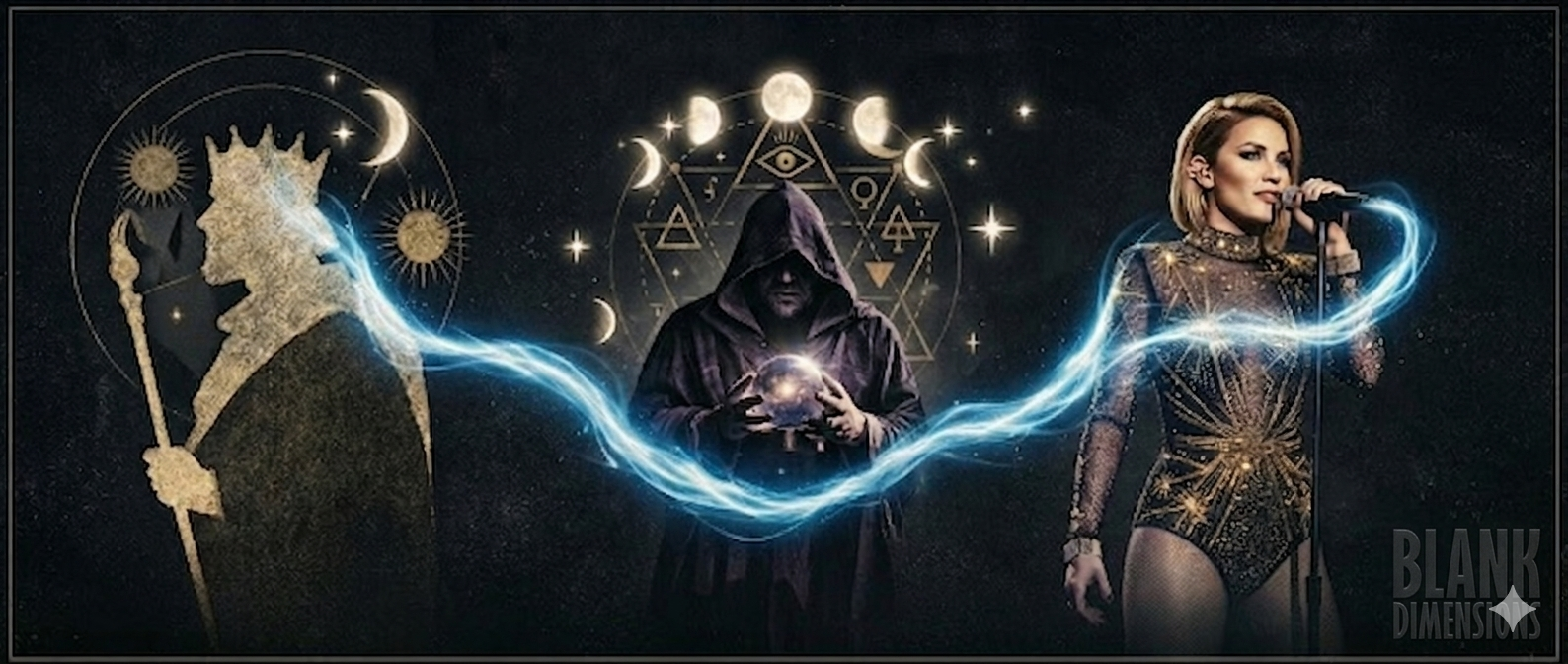
The Hidden Patterns Behind Power, Symbolism, and Influence
From ancient kings to modern pop stars — a meditation on those who learned to dance with the invisible current that runs through all things.
First Law of Thermodynamics · 1842
“Energy cannot be created or destroyed —
only transformed from one form to another.”
Physics taught us this. But the occult lived it long before the textbooks. Every mystic, every king, every strange and brilliant figure who ever rearranged the world around them understood something quietly radical: the universe is not a fixed thing. It is a current. And like any current — it can be redirected.
We often watch someone’s reality shift and call it luck. We call it timing, or talent, or privilege. But sometimes — when we look carefully, in the low light, at the symbols they chose and the rituals they kept and the beliefs they held like a flame against the wind — we begin to ask a different question.
Were they working with something we don’t yet have language for?
This is not a piece that tells you what to believe. It is an invitation to look — at figures across history and pop culture — and notice the patterns. The common thread running through all of them is this: each one understood that energy, attention, and intention are not passive forces. They are levers.
The dance of light and dark. You never quite know who is leading.
Figure I
Aleister Crowley
The Great Beast · 1875–1947 · Ceremonial Magician & Occultist
He named himself The Great Beast. He signed letters with “666.” He was called, by the tabloids of his era, “the wickedest man in the world” — a label he didn’t exactly resist. But beneath the theatre was a man who spent his entire life devoted to a single obsession: the mechanics of Will.
Crowley founded Thelema — a philosophical and magical system built on the declaration that every individual possesses a True Will, a divine purpose that, once discovered and followed with absolute conviction, would align them with the cosmic order itself. His central law, received during a mystical experience in Cairo in 1904 and recorded in The Book of the Law, was deceptively simple: “Do what thou wilt shall be the whole of the Law.”
This was not a license for hedonism — though he was mistaken for that too. It was something more precise. Crowley defined Magick (his spelling deliberate, to distinguish from stage tricks) as “the Science and Art of causing Change to occur in conformity with Will.” In other words: reality bends toward those who know what they want and align every layer of themselves — thought, ritual, attention, intention — in its direction.
The most common cause of failure in life is ignorance of one’s own True Will, or of the means by which to fulfil that Will.
— Aleister Crowley, Magick: Book 4
He studied under the Hermetic Order of the Golden Dawn, practiced Hindu yoga and Buddhist meditation in India, climbed mountains, wrote prolifically, and built a magical order — the Ordo Templi Orientis — that still exists today. His influence runs underneath nearly every Western occult tradition that followed: from Wicca to chaos magick to the ceremonial circles that still meet in quiet rooms around the world.
Whether you find Crowley repellent or magnetic — and most people feel some of both — his framework poses a question that remains unsettling in its clarity: How much of what we call “destiny” is simply the result of someone, somewhere, deciding precisely what they willed?
Figure II
King Solomon
The Wise King · Ancient Israel · Builder of the First Temple
Before Crowley, before the grimoires, before the lodges and the orders — there was Solomon. And in the tradition of Western esotericism, he is the original architect of energy manipulation.
The Biblical King Solomon, son of David, is described in 1 Kings as a man to whom God granted wisdom beyond measure. But in the esoteric traditions — Jewish mysticism, Arabic alchemy, Hermeticism, Freemasonry — that wisdom took on a far more extraordinary dimension. Solomon was said to have commanded demons and angels alike to build the First Temple in Jerusalem. Not with brute force, but with knowledge — specifically, the knowledge of how invisible forces are ordered, named, and directed.
The Key of Solomon — a grimoire compiled during the medieval period drawing on much older traditions — describes a system of 44 planetary seals: geometric symbols, each mapped to a celestial force, a divine name, and a specific intention. These were not decorations. They were, in the tradition’s logic, energetic conduits — ways of speaking to the architecture of the universe in its own language.
The Temple of Solomon was only one of many ancient structures that drew on the temple tradition — used to accumulate and direct energy throughout history.
— John Michael Greer, The Secret of the Temple
Freemasonry — arguably the most influential secret society of the modern age — centres its entire mythology around the building of Solomon’s Temple. The Temple is not just a historical monument. In esoteric terms, it is a blueprint for the human interior: a perfect proportional structure that, when replicated in stone, in ritual, or within the self, creates a dwelling place for something higher.
The Golden Ratio. The Pi proportion. Sacred geometry encoded into every dimension. Early Renaissance Cabalists wrote that the Temple was built “in accordance with the unalterable laws of cosmic geometry” — reflecting the idea that physical form, when correctly ordered, becomes a lens for non-physical energy.
You don’t have to believe Solomon literally commanded spirits. But the tradition invites a question that echoes forward through centuries: What happens when a human being builds their life — or their space — in alignment with invisible laws, rather than against them?
Figure III
Taylor Swift
The Mastermind · b. 1989 · Musician, Cultural Architect
She calls herself The Mastermind. It’s the title of a track. It’s also, perhaps, the most accurate self-description she’s ever offered.
Taylor Swift may be the most visible example in our current cultural moment of someone who has built a practice — whether conscious or intuitive — around the energetic power of number, intention, and narrative.
The number 13 is her talisman. Born on the 13th. She writes it on her hand before every show. Her album Fearless won Album of the Year on February 13. The 13th track on Red (Taylor’s Version) is titled “The Lucky One” — with a 13-second intro, and the word “lucky” spoken exactly 13 times. She has said in an interview: “The numerology thing — when it doesn’t take over on its own, I sort of force it to happen.”
Numerology is the ancient practice of assigning vibrational meaning to numbers — a system that appears in Kabbalah, in Pythagorean mysticism, and in virtually every esoteric tradition worldwide. The logic: numbers are not merely quantities. They are qualities. They carry resonance.
Taylor Swift has always been an astrology girl who knows how to read the stars — releasing albums during Venus Star Points, aligning announcements with eclipses.
— Parade Magazine, June 2025
She released Midnights during the same week as a Venus Star Point Cazimi — an astronomical event known in astrological tradition to amplify creative output. Her announcement of Reputation came during a solar eclipse. Whether these are deliberate or deeply habitual, the effect is the same: an alignment of personal narrative with cosmic rhythm that amplifies every release into something that feels, to millions, like fate.
Is she a witch? Almost certainly not in any meaningful sense. But is she someone who has learned — whether through research, instinct, or sheer force of will — to make the universe feel like it is bending toward her? The evidence suggests: yes, deliberately so.
The Law of Conservation of Energy suggests that what she was always going to become was already there. She just found the form. And then she found the timing.
Figure IV
Sabrina Carpenter
The Transmuted · b. 1999 · Artist, Reinvention Study
There is a version of Sabrina Carpenter that most people have forgotten. The Disney Channel fixture. The Girl Meets World co-star. The girl-next-door voice in a bright room.
And then — slowly, deliberately, almost alchemically — there is the version that arrived: Espresso. Song of the Year at the 2024 MTV Video Music Awards. The warm-honey voice and the knowing smile and the old-Hollywood glamour that felt both nostalgic and completely new. A reinvention so total it felt less like a rebrand and more like an emergence.
What happened? On one level, the answer is mundane: hard work, better collaborators, a breakthrough album cycle, a Taylor Swift tour that introduced her to a hundred million new ears. But there’s something worth sitting with beneath the industry mechanics.
She shifted her energetic frequency. The way she moved in rooms. The way she dressed — not louder, but more intentional. The aesthetic she began to embody — golden, warm, cinematic, a little retro, a little witchy — was coherent in a way her earlier image never quite was. She stopped performing a version of herself she had inherited and began constructing one she had chosen.
She has grown up before our eyes — not just in terms of personal style, but in the coherence of the world she has built around herself.
— Entertainment Now, November 2025
In occult terms, this is recognisable as an act of glamour — not in the modern cosmetic sense, but in the old one. In Scottish folklore and early magical tradition, a glamour was a spell cast over the perception of reality. To glamour was to reshape how the world saw you — by first reshaping how you saw yourself.
Sabrina Carpenter didn’t change what she was. She changed the lens. And the universe, as it tends to, followed.
Figure V
The Political Manipulator
A Pattern Across History · From Napoleon to Modern Power Brokers
Politics, at its core, is the art of directing collective energy. The crowd. The nation. The narrative. The fear. The hope. The righteous anger. None of these are abstract — they are energetic states that can be observed, measured in bodies gathered in squares, and — with enough skill — redirected.
Every effective political figure in history has understood, consciously or not, that reality is shaped by perception, and perception is shaped by symbol. The Roman emperors built monuments at precise intersections — not just for beauty, but to create spatial experiences that produced awe. Napoleon was obsessed with ceremony: his coronation was not merely a legal event but an elaborate ritual of energy transfer, designed to make visible what could not otherwise be proved — that the mantle of history had passed to him.
Modern political actors understand the same mechanics, whether they read it in those terms or not. The rally as ritual. The flag as talisman. The enemy as necessary shadow — because light, as any student of the occult knows, requires its opposite to be perceived.
Power is not held. It is performed — over and over, in ceremony and symbol, until the audience forgets it is a performance at all.
— A recurring observation across political theory and esoteric tradition
This is not an endorsement of any political figure or agenda. It is an observation: the manipulation of collective energy is the oldest technology in human civilization. It predates democracy. It predates writing. It is, in its essence, the same science that Crowley studied in ceremonial chambers and Solomon encoded in temple geometry — applied to the bodies and minds of millions.
The question the occult tradition always returns to is not whether energy is being directed. It is: toward what? And by whom? And with what consequence?
Figure VI
The Shadow Side of Power
Warning Light · On Ritual, Secrecy, and Exploitation
We would be dishonest — and the brand of Blank Dimensions requires honesty above all — if we only discussed energy manipulation as an art of the noble and the visionary.
The same current that Solomon used to consecrate a temple has, throughout history, been channelled into spaces of secrecy, exploitation, and harm. The history of secret societies, elite gatherings, and occult ritual contains within it a shadow that deserves acknowledgment: not all energy manipulation is sacred. Some of it is predatory.
There are documented historical cases — from the mystery cults of ancient Rome to the more recent revelations about powerful men and private islands — where the language and aesthetics of esoteric ritual were used not to elevate but to bind. To create psychological and energetic states of dependency, shame, and control. Where the very secrecy that can protect sacred practice was weaponised to conceal harm.
The occult tradition itself has a name for this distinction. It is the oldest one in the book: light and dark. The Great Work and its inverse. The magician who seeks alignment with the cosmic will — and the sorcerer who seeks only dominion.
Energy is neither good nor evil. Intent is the variable. And intent, unlike energy, can always be hidden.
— Blank Dimensions Editorial Reflection
We hold this section not to sensationalise, but to illuminate. Because a community of seekers — which is what Blank Dimensions is building — must have the discernment to recognise when sacred language is being borrowed to serve profane ends. The same symbols. The same aesthetics. Very different intentions.
This is why curiosity, as we say, must always travel with critical sight. The unseen is real. But so is the human capacity to exploit it.
What the Law of Conservation actually means for us
Energy cannot be created or destroyed. Which means — and this is the quiet radical implication — everything you are feeling right now has always existed in some form, and will continue to exist in some form. It is only the container that changes.
The figures in this piece — the brilliant, the calculating, the dangerous, the transcendent — all understood one thing: you do not wait for energy to find you. You learn its shape. You learn its language. You meet it in your ritual, your intention, your number, your symbol, your daily practice of refusing to let reality be fixed.
Some of them bent that understanding toward light. Some toward shadow. The universe, as the first law tells us, does not judge the transformation — only records it.
The question, always, is yours: What will you do with the current while it moves through you?
References & Further Reading
- Wikipedia — Aleister Crowley & Thelema. Last updated 2026. en.wikipedia.org/wiki/Aleister_Crowley
- Britannica — “Thelema.” Encyclopædia Britannica. britannica.com/topic/Thelema
- Crowley, Aleister. Magick: Book 4. Weiser Books, 1994.
- Hebrew Bible — 1 Kings 4:29–34 (Solomon’s wisdom and knowledge of the natural world).
- Greer, John Michael. The Secret of the Temple: Earth Energies, Sacred Geometry, and the Lost Keys of Freemasonry. Inner Traditions, 2016.
- Wasserman, James. The Temple of Solomon: From Ancient Israel to Secret Societies. Inner Traditions, 2011.
- Setnakh.com — “The 44 Seals of King Solomon: Origins, Symbolism, and Modern Esoteric Practice.” July 2025. setnakh.com
- Freemason Information — “King Solomon’s Temple as a Symbol to Freemasonry.” freemasoninformation.com
- Parade Magazine — “Why Is Taylor Swift Obsessed With the Number 13? Numerology Explains.” June 16, 2025. parade.com
- Orson, Kate. “Taylor Swift says she’s a Christian. But her music is filled with pagan references.” Premier Christianity. April 2024. premierchristianity.com
- The Shade Room — “Taylor Swift and the Hidden Power of Numerology: Decoding Her Destiny Matrix.” theshaderoom.com
- Entertainment Now — “Sabrina Carpenter’s Viral Throwback Shows Off Her Stunning Transformation.” November 2025. entertainmentnow.com
- The Tab — “From Disney star to it girl: A look at Sabrina Carpenter’s transformation.” June 2024. thetab.com
- Pew Research Center — “Occult Practices in America Survey.” May 21, 2025. (Reported via EEW Magazine, June 2025.)
- Stack Magazines / VICE — Behind the scenes: Sabat Magazine (cultural competitor analysis). stackmagazines.com
- Kantorowicz, Ernst. The King’s Two Bodies: A Study in Mediaeval Political Theology. Princeton University Press, 1957.
Leave a Reply