The Black Sun is a wheel of twelve zigzag spokes around a ring. It is told as the oldest sign of all, a sun that burns unseen behind the one we see. Two different things go by this name, and it matters which one you mean.
The sun that goes down
The Egyptians told it this way. Each evening the sun god Ra sailed into the western horizon and entered the Duat, the underworld. For twelve hours his barque passed through the gates of the night, past the dead who woke to greet him, with the serpent Apep coiled in the dark to swallow the boat. Mehen wound around the cabin to guard him. At the last gate Ra was born again as the morning sun. The alchemists carried the same pattern into their work. Every making begins with a descent into the dark, and the dark sun is the one that burns there.
The sign on the castle floor
The twelve-spoked wheel as it is known today comes from a floor mosaic in Wewelsburg castle in Westphalia. Heinrich Himmler, head of the SS, took the castle over in 1934 to make it a ceremonial centre for the order. The mosaic lies in the hall of the SS generals. It is a sun wheel built from twelve Sig runes, the lightning-bolt rune that the SS used in its own insignia.
The mosaic was made for Himmler. It draws on older sun-wheel forms, but it was not handed down from a lost people. The name Black Sun, Schwarze Sonne, came later. The former SS officer Wilhelm Landig wrote a black sun into a postwar mythology of hidden survivors and secret refuges, and the Wewelsburg mosaic was first identified with it in a German novel of 1991, Die Schwarze Sonne von Tashi Lhunpo. Nicholas Goodrick-Clarke followed the whole development in Black Sun: Aryan Cults, Esoteric Nazism and the Politics of Identity (2002).
Since then neo-Nazi and white supremacist groups have taken the wheel up to claim an ancient European inheritance. The Anti-Defamation League lists the sun wheel as a hate symbol in this use, and notes that many other sun wheels have nothing to do with it. Anyone who draws the Wewelsburg pattern draws that history with it.
The older black sun
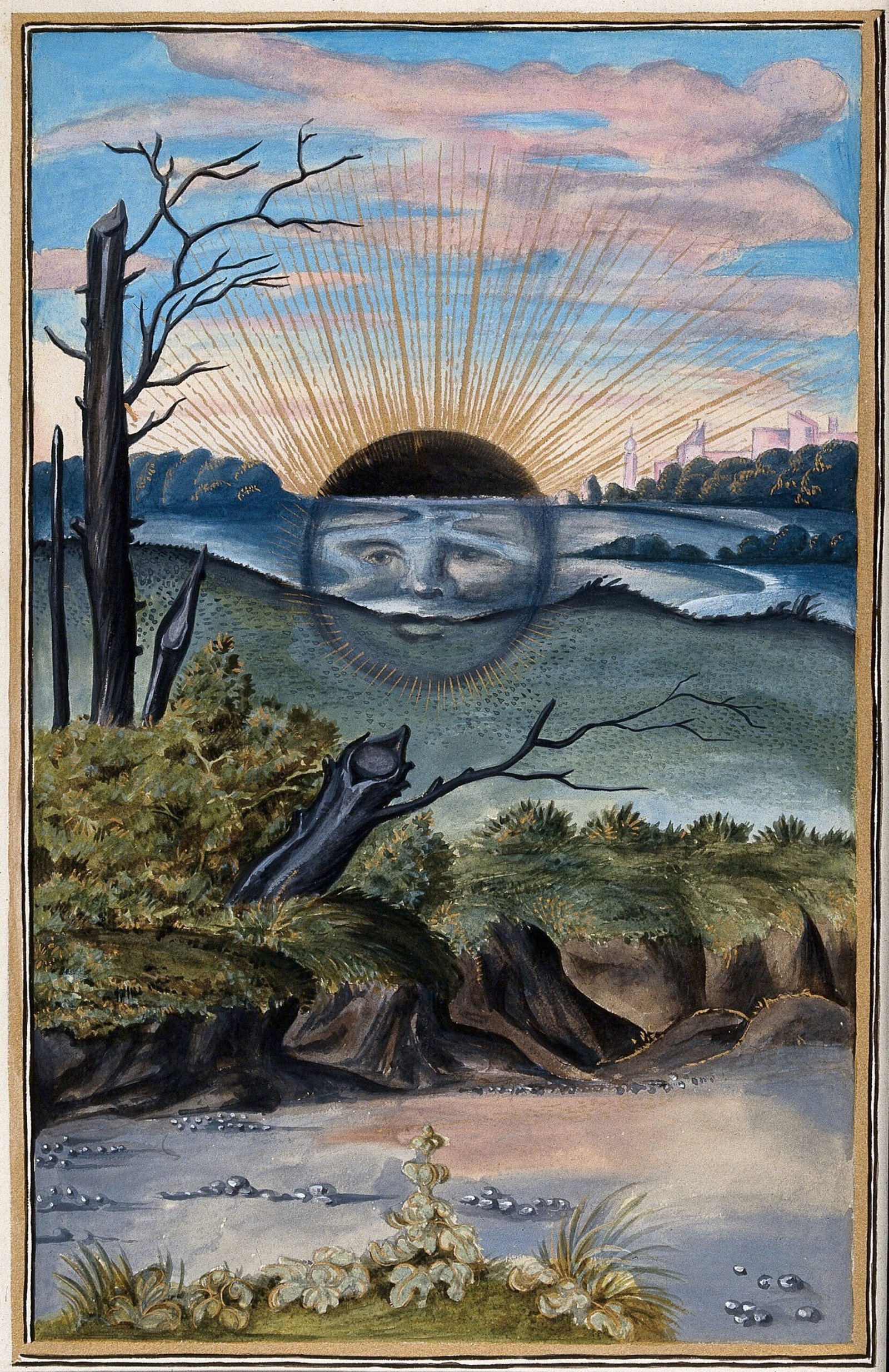
The black sun the alchemists wrote of is a separate sign. They called it the sol niger. It is the sun of the blackening stage of the work, the nigredo, where the old form is burned away and dissolved so that something truer can be made. It belongs to Saturn and to lead, the heaviest of the metals, and it is where the work begins.
Carl Jung wrote of it in his late studies of alchemy as the dark phase that comes before renewal. The French poet Gérard de Nerval put a black sun over the melancholy of his poem El Desdichado in 1853, and Julia Kristeva borrowed the phrase for her 1987 book on depression. In Paris in 1927 Harry and Caresse Crosby named their press the Black Sun Press.
What the tradition says it means
In alchemical and mystical writing the black sun is the sun that works unseen, the source behind visible light. Some mystics speak of an inner sun, a fire in each person that burns beyond the opposites of light and dark.
The dark night of the soul is the same passage in another language. The self that was sure of its own light goes out, and something that was waiting underneath comes up in its place.
How it is used
Practitioners take the black sun into meditation on the dark night of the soul, into shadow work and into rites of rebirth. The Saturn practices that go with it use lead, the colour black and the hour of Saturn.
The sign to work with is the alchemical or inner sun. The Wewelsburg wheel belongs to a different history, and the two should be kept apart.
The record in brief
1934: Himmler takes over Wewelsburg for the SS. The 1930s and 1940s: the sun wheel of twelve Sig runes is laid in the floor of the hall of the SS generals. The 1950s: a postwar mythology of a Black Sun circulates in neo-Nazi circles, linked to Wilhelm Landig. 1991: a German novel identifies the mosaic with the Black Sun. 2002: Goodrick-Clarke publishes the standard account.
Next
The Eye of Providence: Meaning, Origin and the Dollar Bill. The next sign is an eye inside a triangle. It sits on the American dollar bill, and nearly everyone who has handled one has wondered about it.
This page is part of the ten-sign guide: Occult Symbols and Meanings.
Sources
- Goodrick-Clarke, Nicholas, Black Sun: Aryan Cults, Esoteric Nazism and the Politics of Identity (2002); The Occult Roots of Nazism (1985).
- Anti-Defamation League, “Sonnenrad”, Hate on Display database.
- Jung, C. G., Mysterium Coniunctionis (Collected Works, vol. 14).
- Kristeva, Julia, Black Sun: Depression and Melancholia (1987).